
Shanty, Folk, or Maritime Ballad?
Untangling the Songs We Sing
Across the UK and Europe, when people hear The Rusty Tubs sing, one of the questions that comes up again and again is: “Is Wellerman really a sea shanty?” And it’s a fair question. Our set is full of songs that smell of salt and tar, but not all of them were sung to haul ropes or turn capstans. Some are work songs, some are stories, some are just cracking good folk songs that happen to feel at home in The Rusty Tubs setlist.
So where do sea shanties end, and where do folk songs or maritime ballads begin? Historically, many of these songs had specific jobs to do, shaped by the work they accompanied and the rhythms sailors needed. But the deeper you go, the clearer it becomes that the labels we use aren’t neat little boxes. They’re tools for understanding, not strict rules to police.
Our setlists reflect that messy, shared musical world. Alongside true working sea shanties, we sing maritime ballads and traditional folk songs. They’re all cut from similar cloth, but doing different things. In this post, we’ll untangle those differences using the songs we sing as our guide, explore a few of the subtypes of sea shanties, and show why a bit of variety doesn’t muddy the waters, it makes for a better night of singing.
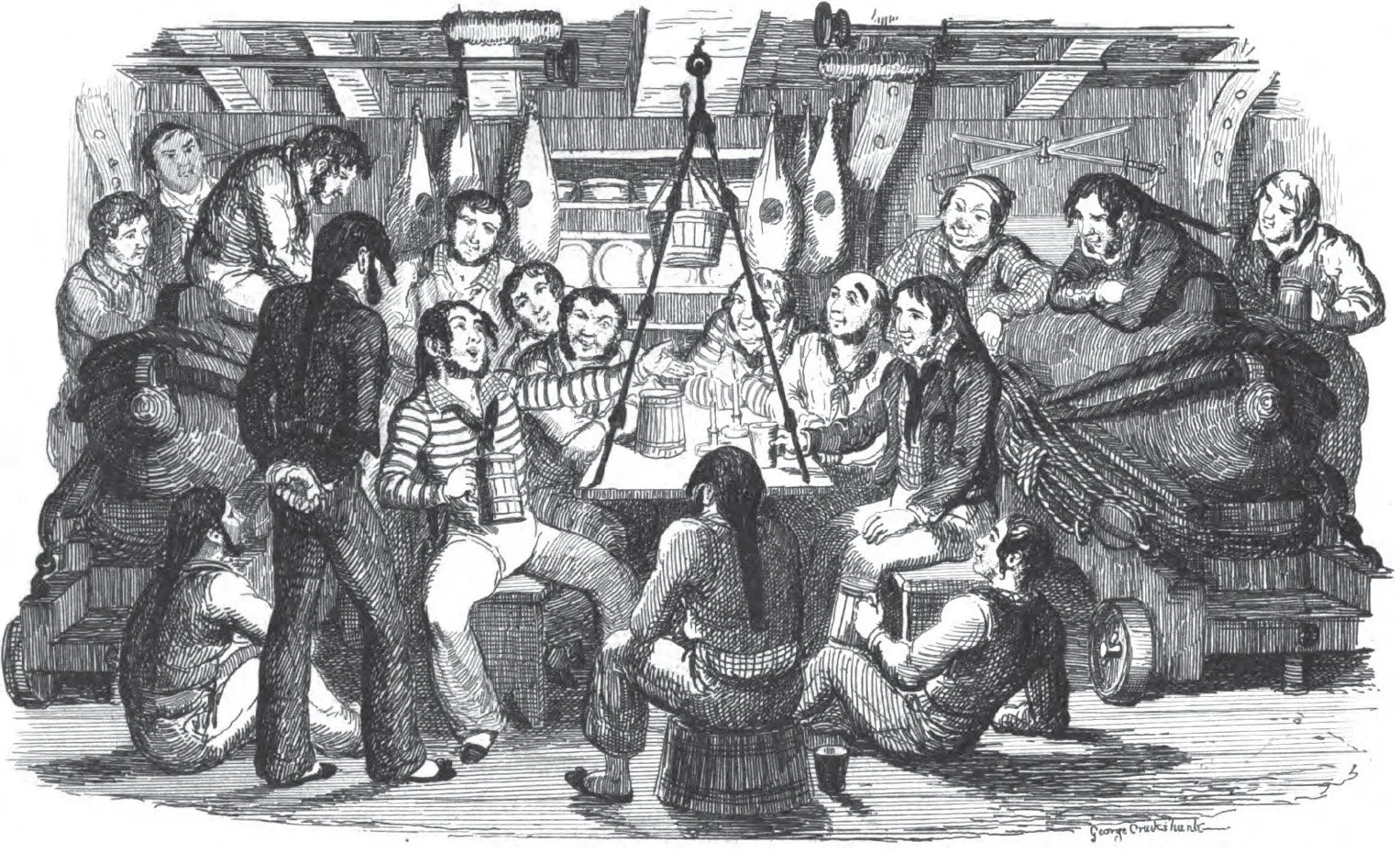
An illustration from the book "Songs, naval and national" by Thomas Dibdin, published in London, England in 1841
What Makes a Sea Shanty a Shanty
At its heart, a sea shanty (or chanty) is a working song. These were not songs sung about the sea, but songs sung to do a job, most commonly aboard large sailing vessels in the 18th and 19th centuries. Shanties helped sailors keep time during heavy, rhythmical labour. Hauling on ropes, setting sails, or walking a capstan round and round. The word shanty itself appears in the mid-19th century, possibly derived from the French chanter, meaning “to sing”, though the practice of singing at work aboard ships is almost certainly far older than the name we now use for it.
Because shanties were functional, their musical form was shaped by necessity. They needed a strong, steady rhythm and a structure that allowed a whole crew to join in, often while short of breath and mid-effort. Most shanties use a clear chorus or refrain, and many follow a call-and-response pattern: the “shantyman” delivers the lines, while the rest of the crew answers back with short, powerful responses. Those responses weren’t just for fun; they often marked the exact moment to pull, heave, or step, locking the crew together in time as surely as any drum.
Of course, the reality aboard ship was rarely so tidy. There were as many variations of shanties as there were jobs to be done, and plenty of songs were happily reused, adapted, or pressed into service wherever they fitted. Rather than trying to catalogue every last example, we’re going to focus on a handful of the most commonly recognised working types: Short-Drag, Halyard, Capstan, and Stamp and Go shanties. Each is tied to a particular kind of labour, and that work shaped the rhythm, structure, and feel of the songs themselves, which is why they still sound so different today.
Short-Drag Shanties
Short-drag shanties were used for jobs that needed short, powerful bursts of effort, such as trimming sails or hauling in sheets and braces. These tasks didn’t call for long, steady pulling, but for everyone to throw their weight on the rope at the same moment. As a result, the songs are sharp, direct, and built around timing rather than endurance.
That work shaped the music. Short-drag shanties usually feature a strong chorus with one decisive pull on the final word or phrase. The verses set things up, but all the energy lands at the end exactly when the crew heaves together. Songs like Haul Away Joe, Haul on the Bowlin’, and Boney are classic examples, and it’s easy to see why they still thrive in modern sessions: bold, loud, and perfect to get a room singing as one.
Halyard Shanties
Halyard shanties were sung for longer, heavier hauling jobs, most famously when hoisting yards up the mast using halyards. This wasn’t a quick yank and reset, but sustained work that could go on for minutes at a time, demanding coordination and stamina rather than sudden force. The song’s job was to keep the crew moving together through repeated pulls.
That slower, steadier labour is reflected in the music. Halyard shanties typically feature two pulls per chorus, spaced to match the rhythm of the work. This gives more room for the shantyman to stretch out the solo lines, spin stories, or improvise verses, while the crew answers back at predictable moments. Songs like Blow the Man Down, Hanging Johnny, Whiskey Johnny, and A Long Time Ago show this perfectly. Less explosive than short-drag shanties, but driving in their own way, built for endurance and collective effort.
Capstan Shanties
Capstan shanties were used for some of the heaviest and most sustained work aboard ship, most famously raising the anchor. The rope was wound around a large vertical winch, the capstan, and sailors would walk it round by pushing on wooden bars, step after step. Unlike hauling on a rope, this was a continuous motion, sometimes going on for a long while, and the music needed to support steady movement rather than mark specific pulls.
Because of that, capstan shanties tend to be more expansive and flowing. They often feature longer solo verses and a big, memorable chorus that everyone can sing while keeping their feet moving. While many still use a call-and-response structure, the emphasis is less on timing a heave and more on maintaining momentum. Songs like Santianna, Paddy Lay Back, Rio Grande, Clear the Track, Let the Bulgine Run, Shenandoah, and John Brown’s Body show how these shanties blur into ballad territory. Slower, broader, and built to carry a crew through long, grinding work.
Stamp and Go Shanties
Stamp and go shanties, also called walkaway or runaway shanties, accompanied hauling jobs where the crew didn’t pull in bursts but walked the rope away across the deck. Sailors would take hold of the line and march forward together, backs to the rope, turning hauling into a steady, continuous movement rather than a series of sharp tugs.
Because the work didn’t stop and start, these shanties often have longer choruses, closer in feel to capstan songs than short-haul shanties. They needed to keep everyone moving at the same pace, boots stamping in time. On large naval vessels, this rhythm was often set by drums or a boatswain’s whistle rather than singing, which is one reason relatively few walkaway shanties were recorded. Drunken Sailor is the most famous survivor and likely one of the few shanties ever officially tolerated aboard Royal Navy ships.
Maritime Songs (Not Shanties, Still Seafaring)
Not every song sung at sea was a shanty. Maritime songs are tied to life afloat, coastal communities, and the sailor’s world, but they weren’t designed to make work easier. These are songs sung about the sea rather than to it, for leisure, reflection, storytelling, or simply passing the time.
Because they aren’t bound to a job, maritime songs are freer in structure. They don’t need a timed pull or a shouted response, which means they can be slower, more melodic, or more narrative. Ballads like Spanish Ladies or Rolling Down to Old Maui paint vivid pictures of home, hardship, longing, and landfall, the emotional counterweight to the hard graft of working shanties.
Plenty of these songs have been pulled into modern “shanty” sets, ours included, because they feel right alongside the work songs. They still carry salt, wind, and distance in their bones, even if no one ever hauled a rope to them.
Traditional Folk Songs in a Shanty Set
Then there are the songs that aren’t really maritime at all, at least not by origin, but still earn their place in a shanty crew’s repertoire. Traditional folk songs often share the same DNA as shanties: simple structures, memorable choruses, and stories meant to be sung communally rather than performed at an audience.
Many sailors learned their songs ashore before ever going to sea, and they brought those melodies with them. It’s no surprise that the line between folk song and sea song gets blurry. When a chorus is big enough, the rhythm strong enough, and the story robust enough, it doesn’t really matter where the song started: it’ll thrive in a room full of voices.
That’s why you’ll hear us sing songs that owe more to the pub, the road, or the countryside than the deck of a ship. They work because they invite people in, and that’s always been the point.
Matt and Derf hollering a chorus… or possibly ordering another beer!
Why Variety Makes a Great Setlist
A full night of singing nothing but hauling shanties would be historically accurate and absolutely exhausting. Sailors didn’t work non-stop, and neither should a good setlist. Mixing shanties, maritime ballads, and folk songs gives shape and flow: fast and loud numbers to raise the roof, slower songs to let the room breathe, and big choruses to pull everyone back together.
That variety also reflects the reality of the tradition. The songs sailors sang weren’t neatly categorised in the moment. They were chosen because they worked, whether that meant keeping time, lifting spirits, or killing an hour between watches. We do the same thing now, just with fewer ropes and more pints.
So when someone asks, “Is Wellerman really a sea shanty?”, the honest answer is “No, it’s a song of the sea”. But does that mean it doesn’t belong in a shanty shout? Not a bit. What matters is that the song does its job. If the whole room is singing by the final chorus, it’s a success in our book."
