
Songs on the Severn: Why These Gloucester Boys Sing Sea Shanties
Gloucestershire may not be the first place that comes to mind when you think of sea shanties. We have no rugged coastline, no fishing harbour and considerably more cider orchards than salt spray. Yet The Rusty Tubs have spent years singing songs of sailors, ships, distant ports and hard lives at sea.
At first glance, that might seem like an unlikely match. But Gloucester has a much deeper connection to the maritime world than its inland location suggests. For centuries, the River Severn, Gloucester Docks and the Gloucester and Sharpness Canal connected the city with the Bristol Channel and ports across Britain, Europe and beyond. Ships, cargoes and sailors once travelled directly into the heart of Gloucester, helping to shape the city we know today.
That history is still visible in the docks, warehouses, bridges and working dry docks. It remains alive through the festivals, businesses, museums and shanty groups that continue to gather there.
So why does a Gloucestershire band sing songs of the sea? The answer lies partly in Gloucester’s maritime past, partly in the enduring power of the songs themselves, and partly in a festival that appeared to offer free beer.
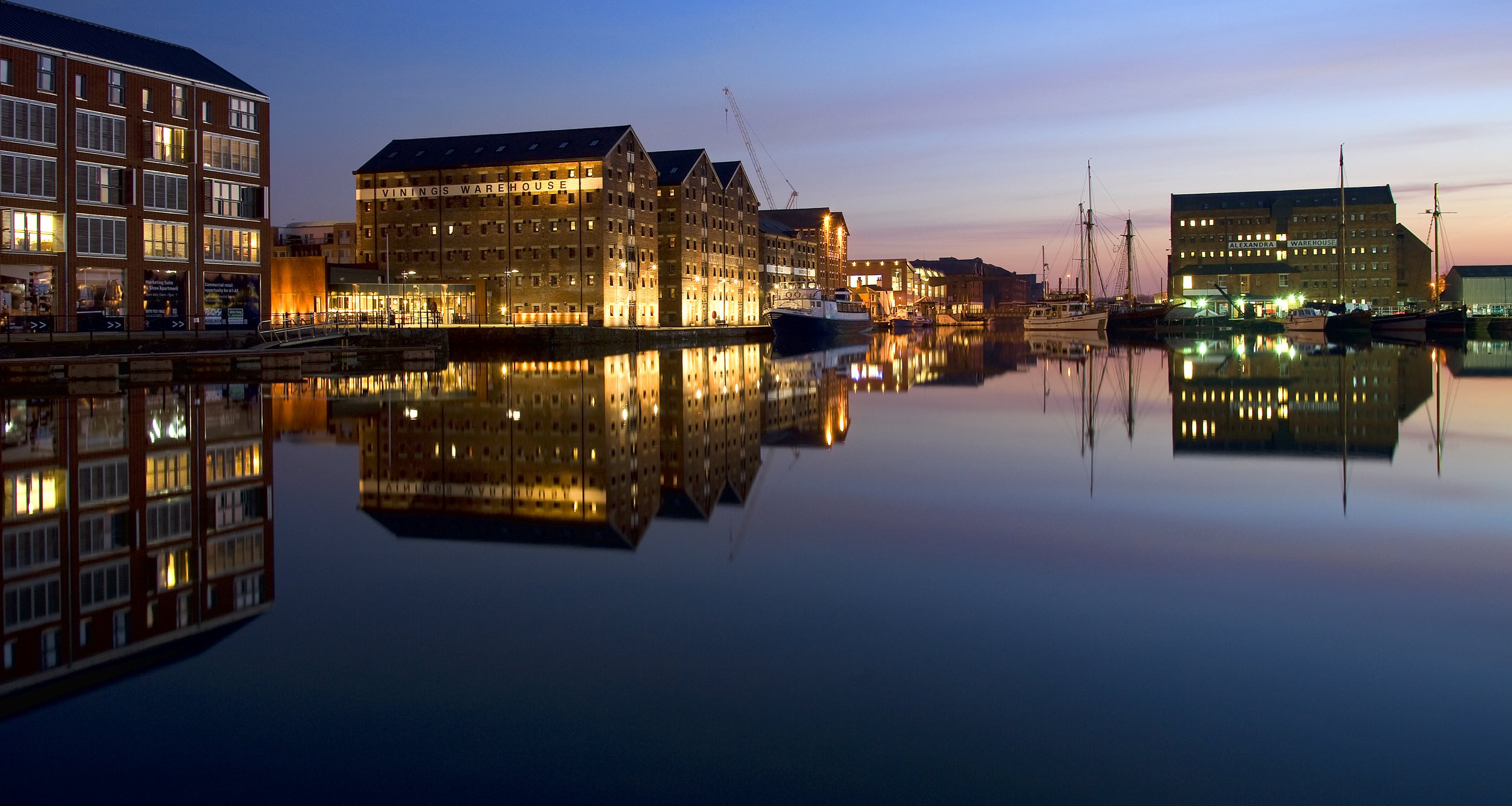
Gloucester Docks at night, Saffron Blaze
Gloucester: An Inland City with a Maritime History
Gloucester has no shortage of history. Founded as a Roman fortress, the city later grew around the great Abbey of St Peter, now Gloucester Cathedral, and famously resisted the Royalist army during the Siege of Gloucester in 1643. These stories remain central to the city’s identity.
Yet Gloucester’s history is also written in water. Despite lying well inland, the city stands on the River Severn and is home to Britain’s most inland port. For centuries, the river connected Gloucester with communities downstream, the Bristol Channel and eventually overseas markets. Maritime trade was not a minor footnote in the city’s development; it helped shape Gloucester’s economy, buildings and relationship with the wider world.
The first surviving written reference to a quay at Gloucester dates from 1390, although a riverside quay is known to have existed since Saxon times. In 1580, Elizabeth I granted Gloucester formal port status, allowing merchants to trade directly with foreign ports. By 1780, around 600 boats were berthing in the city each year.
Reaching Gloucester was not easy, however. The upper River Severn was tidal, unpredictable and particularly hazardous for larger sea-going vessels. Gloucester was already a busy inland port, but its geography placed a natural limit on further growth. The solution would be one of the most ambitious engineering projects in the county’s history: the Gloucester and Berkeley Canal, now known as the Gloucester and Sharpness Canal.
The Gloucester and Sharpness Canal: Bringing the Sea Inland
In 1793, Parliament authorised the Gloucester and Berkeley Canal Company to construct a new dock and ship canal, allowing vessels to bypass the most hazardous stretch of the Severn.
Work began the following year, but the scale of the project soon exhausted the company’s funds. By 1800, the company’s original funds had run out with the canal still far from complete. Construction stalled until the celebrated engineer Thomas Telford became involved. The original route towards Berkeley was shortened, with the canal instead meeting the Severn at Sharpness.
When the Gloucester and Sharpness Canal finally opened in 1827, it was the largest canal in England. At approximately 16 miles long, 86 feet wide and 18 feet deep, the new canal finally allowed sea-going vessels from around the world to travel to the heart of Gloucester!
The canal strengthened Gloucester’s connections with Britain, Europe and beyond. It transformed the city with warehouses, dry docks and new quays. For an inland city, the canal effectively brought Gloucester to the sea, and the sea was better for it!
Gloucester Docks Today: A Living Maritime Heritage
Today, Gloucester Docks is often associated with the Gloucester Quays Designer Outlet, but the area is much more than a shopping destination. The historic port remains one of the city’s most distinctive places, where museums, leisure boats and traditional shipbuilding operate among fifteen listed historic warehouses, most of them Victorian. The National Waterways Museum occupies the Grade II-listed Llanthony Warehouse, built as a grain store in 1873, while the Soldiers of Gloucestershire Museum is housed in the former Custom House.
Old warehouses have meanwhile found new purposes. Warehouse 4 is now home to Gloucester Brewery, a favourite of The Rusty Tubs for obvious reasons. Its brewery, distillery, taproom and entertainment venue bring people together beside the same basin once crowded with merchant vessels and cargo. It is a modern business, but one that remains closely tied to the character and community of the docks.

The Mariners' Chapel at Gloucester Docks by Steve Daniels
Gloucester Docks are more than a preserved industrial landscape. Their two historic graving, or dry, docks remain in active use. The smaller was constructed in 1818 for vessels trading along the Severn, while the larger opened in 1853 to accommodate ships arriving through the Gloucester and Sharpness Canal.
The docks have also hosted the Gloucester Shanty Festival and the Gloucester Tall Ships Festival, bringing maritime music and vessels back into the heart of the city. 2027 will mark the docks’ bicentenary, with a six-month programme of festivals, events and community projects currently being promoted as Gloucester 200. It will celebrate the people, history and identity shaped by the docks while also considering the city’s future. The cargo ships may mostly have gone, but Gloucester Docks have not become a museum piece. People still work there, gather there, drink there and occasionally make far too much noise there. Naturally, we feel quite at home.
So Why Did These Gloucester Boys Start Singing Sea Shanties?
For The Rusty Tubs, the connection began long before there was a band. We had been singing traditional songs around campfires for years, drawn to the big choruses, close harmonies and stories of sailors, dock workers and working men whose lives were very different from our own.
Then a couple of us went to a sea shanty festival and discovered that groups were apparently being paid in beer to sing these songs in pubs and on stages. That sounded like an excellent arrangement. Things have got slightly out of hand since then.
What keeps drawing us deeper into the music is its connection to the past. Sea shanties and maritime songs carry stories of hard work, long voyages, danger, humour, loss and survival. They give us a glimpse into the lives of the people who sang them, while still leaving space for each new generation to make the songs its own.
Audiences respond to that combination of history and shared experience. A good chorus needs no introduction, and a strong story can hold a room even when the song itself is more than a century old. The best performances feel less like a band singing at an audience and more like everyone in the room becoming part of the song.
What allows us to keep doing it is the community surrounding the music. Gloucestershire has its own thriving shanty scene, but the friendships extend across Britain and far beyond it. Festivals have introduced us to singers and audiences from around the world, all connected by the same old songs and the pleasure of singing them together.
Keeping Gloucester’s Maritime Tradition Alive
Gloucester’s connection with the maritime world is not confined to its buildings, museums and surviving dock infrastructure. It also lives on through the music performed in its pubs, festivals and public spaces.
The Rusty Tubs, alongside groups such as The Gloucester Diamonds, Green Around the Gills and many more, are keeping maritime music alive in Gloucester and across Gloucestershire. We are not part of an unbroken singing tradition passed directly from nineteenth-century dock workers, but we are drawing on the same wider culture of ships, labour, travel, community and shared song.

Us singing in The Drunken Ducken Duck, Gloucester’s smallest pub!
The Rusty Tubs have sung in harbours, docks and quays across the UK and Europe, but our home in Gloucester still holds a very special place in our hearts. Gloucester may be inland, but the sea has been coming up the Severn for centuries. We are simply the latest lot to make a racket about it, preferably with a pint close at hand!
